Best Private Snoring Tracker Apps for iPhone in 2026 (No Wearable Required)
What separates the apps is what the morning number is compared against, where your audio goes, and how you pay. Here is how Nightsong™ and seven other apps answer those questions in 2026.
Published Updated Facts checked
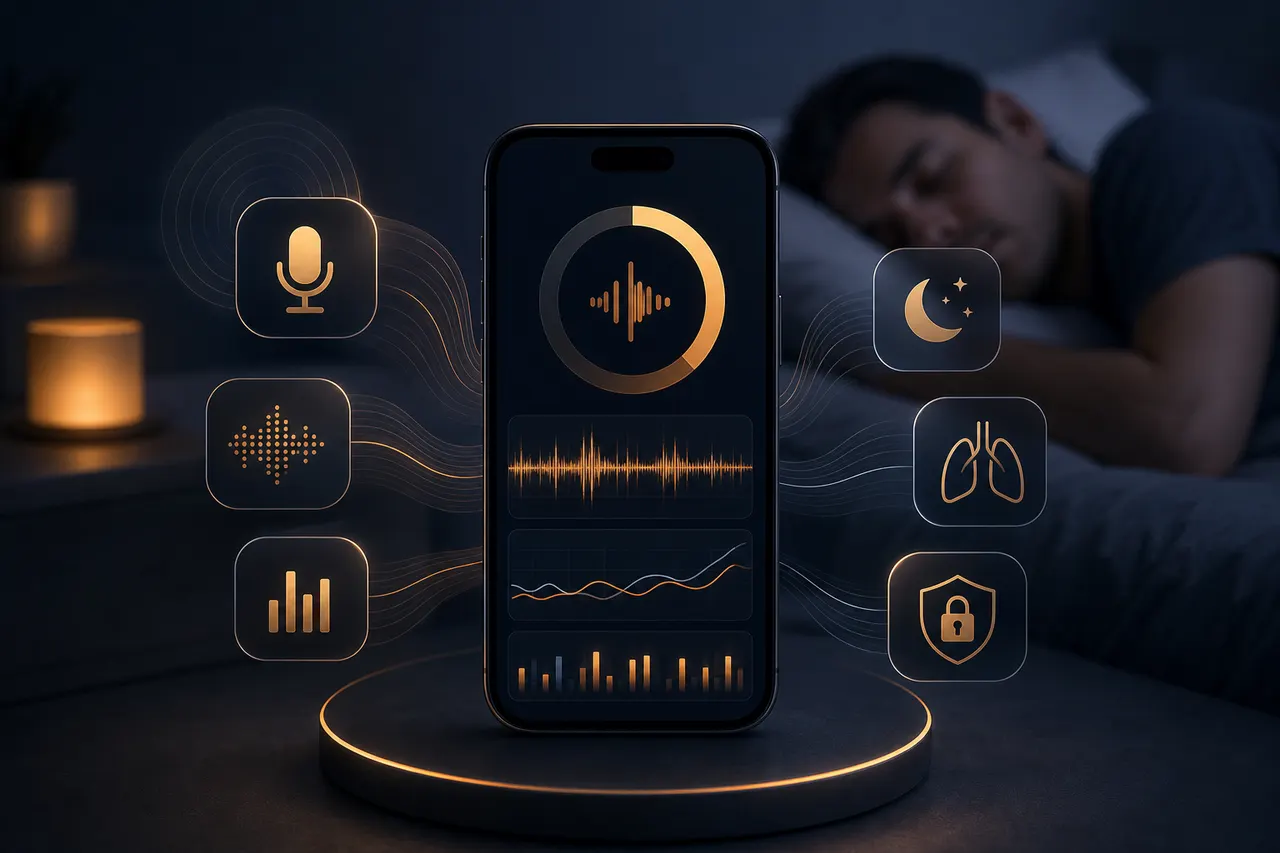
Your partner says you snore. Or you wake up after a full night and still feel like you missed one. Either way, you want to know what happens while you sleep, and you would rather not wear anything to bed to find out.
You don’t have to. The microphone in your iPhone can hear a night well enough to be useful, and a handful of apps are built around it.
The harder question is which one to trust. Not with features, since most of them have plenty. With the sound of your breathing, and with the number you read every morning.
What to look for
Four questions separate these apps more than any feature list.
What is the score compared against? A morning number means little on its own. It starts to mean something when you know what it is measured against, and the fairest comparison is your own nights over time. That is a baseline, not a stranger’s average.
Where does the audio go? Breathing sounds are personal. Some apps analyze them on the phone. Some can send recordings to a server. The App Store privacy label and the developer’s privacy policy are the places to check, along with whether any cloud option is on by default.
What happens when the night was unclear? A phone on a nightstand does not hear every night well. A good app tells you when it could not hear, rather than filling the gap with a guess.
How does it charge? Some apps charge a subscription. Some charge once. Some are freemium, with a free core and paid extras.
Every app below works with just an iPhone. Some add Apple Watch data if you already wear one.
The apps
Nightsong comes first here. The other seven follow, described by what each developer says on its own pages.
Nightsong
Nightsong is the newest app in this comparison.
Your iPhone listens to snoring and breathing overnight. Each morning you get the Somnus Index™, a 0 to 100 wellness score built mostly from snore burden and breathing regularity. Under it sit the plain details: how many minutes of snoring the phone heard, and how steady your breathing sounded.
The score is read against your own baseline over time, never a stranger’s average. Your first nights may show LEARNING while that baseline forms. Of the eight apps here, Nightsong is the only one whose public pages describe a score measured against your own nights.
When the night was not heard well, Nightsong shows no number. That is NO READ, and it is there instead of a guess. If only part of the night was heard well, the Index is marked Partial and reflects the stretch that was heard.
Ask Nightsong™ lets you ask plain questions about your own nights, such as “Was last week better than the week before?” The answers come from your own history. It is wellness only, never a verdict.
Analysis runs on the phone. The morning number is computed there, not by sending your night to a server to get a score back. Your recordings stay on your phone unless you choose to send them. There is no audio backup to turn on.
Nightsong is freemium. The core score and your baseline are the free side. Premium is coaching sessions and snore cards, so you can listen back to your night. Both are in the app today, including during the closed beta. Coaching is wellness support, not a diagnosis. A premium price has not been published.
Nightsong runs on iPhone, Apple Watch and iPad, and Android is coming soon. An Apple Watch can add context, but it is never required. Nightsong is free during a closed TestFlight beta that is currently full, and it is not on the App Store yet.
Where it falls short is plain enough. It is new and in a closed beta, so it does not have SnoreLab’s track record.
It suits you if you want one morning number read against your own nights, analysis that stays on the phone, and an app that would rather show nothing than guess.
SnoreLab
SnoreLab is the long-established app in this category. It runs on iPhone, iPad and Android.
It gives you a nightly SnoreScore, recordings you can play back, and remedy tracking. Premium adds BreathFlow™, a breathing-stability wellness score, along with a Breathing Disturbance Index and breathing rate. Its public pages do not describe a score measured against your own baseline.
Recordings are saved on your device unless you turn on the optional Audio Backup, which stores encrypted recordings on SnoreLab’s server. SnoreLab says the BreathFlow model runs fully on the device. Its App Store privacy label lists some data linked to you, including health data and an email address.
SnoreLab is free with in-app purchases, sold as a subscription. Premium options in the US App Store include $7.99 a month and $39.99 a year, with other options from $5.99 to $59.99. BreathFlow is Premium only, with a 7-day free trial.
It suits you if you want the longest track record, Android, or a breathing-stability score today.
NightSnore
NightSnore is a newer iPhone app built around privacy and a one-time purchase.
It gives you a nightly Snore Index, counted as snore events per hour, plus snore count and duration, a full-night chart, multi-night trends, CSV and PDF export, and built-in sleep sounds. Its public pages do not describe a score measured against your own baseline.
The developer says all audio analysis runs on the iPhone, with no cloud processing and no account. Its App Store privacy label says Data Not Collected.
It is free to download, with unlimited monitoring and a nightly report. A one-time Full Version unlock is listed at $4.99 in the US App Store, and the developer’s site says it rises to $5.99 from Nov 18, 2026. There is no subscription. It runs on iPhone with iOS 17.6 or later, and the developer is running an Android beta.
It suits you if you want on-device analysis and no subscription.
Kip
Kip is an iPhone app that presents itself as a free, private alternative to SnoreLab.
It records and scores snoring overnight, rates the night mild, moderate or severe, and lets you replay the loudest moments and follow changes over time. Kip Pro adds unlimited recording, full trend history and a PDF report. Its public pages do not describe a score measured against your own baseline.
The developer says audio never leaves the phone and there is no cloud upload option. There is no account and there are no ads. Its App Store privacy label lists some usage and diagnostic data, not linked to you.
Kip is free for three nights, then a subscription. The US App Store lists Kip Pro at $2.99 and Kip Pro Yearly at $29.99. It runs on iPhone only.
It suits you if you want a simple, ad-free, on-device start.
SnoreTracker (Freddy Labs)
SnoreTracker from Freddy Labs is a fully offline iPhone snore tracker, currently in private beta.
It offers all-night recording, a 0 to 100 Snore Score, full playback and a timeline, optional Apple Health import, tags, CSV export, and a clinician report PDF. Its public pages do not describe a score measured against your own baseline.
The developer says the app has no account and no analytics, makes no network requests, and keeps recordings out of iCloud and computer backups.
Its price is not stated. The app is in private beta, with an App Store release in preparation. It runs on iPhone with iOS 17 or later.
It suits you if you want a strictly offline recorder and can wait for the public release.
A different app with a similar name appears in the App Store under another developer. This entry refers only to the Freddy Labs app.
Snollo
Snollo is an iPhone snore and sleep-talk recorder that pairs with Apple Watch sleep data.
It records snoring and sleep talking, gives a nightly Sleep Score, and shows sleep stages from Apple Watch, or estimated from the iPhone alone. With a Watch, it adds heart rate, respiratory rate and blood oxygen. Its public pages do not describe a score measured against your own baseline.
The developer says acoustic analysis runs on the iPhone, and that recordings and health logs are stored in your own private iCloud. Its App Store privacy label lists some data linked to you, including health data.
Snollo is free with in-app purchases, sold as a subscription at $5.99 a month or $39.99 a year in the US App Store.
It suits you if you wear an Apple Watch and want snoring and sleep stages side by side.
Sleep Cycle
Sleep Cycle is a well-known sleep app built around a smart alarm. Snore recording is one feature, not the focus.
Its public pages do not say where the score is computed, and do not describe a score measured against your own baseline. Its US App Store privacy label lists data used to track you and data linked to you.
It is free with in-app purchases, sold as a subscription, with Premium options listed from $2.99 to $57.99 in the US App Store. It runs on iPhone, iPad and Apple Watch.
It suits you if waking up more gently matters most, with snoring as a side interest.
SleepScore
SleepScore uses sonar from the phone’s speaker and microphone to follow breathing movement without contact.
Its public pages do not say where the score is computed, and do not describe a score measured against your own baseline. Its US App Store privacy label lists data linked to you, including health and location data.
It is a subscription, with Premium at $9.99 a month or $59.99 a year in the US App Store, each with a 7-day trial. It runs on iPhone.
It suits you if you want a contact-free, sonar-based sleep score and don’t mind placing the phone carefully.
Side by side
Facts checked Nov 12, 2026 from each developer’s site and the US App Store. Nightsong features, including coaching sessions and snore cards, are in the current app. “Not stated” means we could not find it on an official page. Prices change, and the App Store price always applies.
| App | Where the score is computed (per developer) | Can audio leave the phone? | Score compared against | Plain-language Q&A | How they charge (US) |
|---|---|---|---|---|---|
| Nightsong | On the phone | Only if you choose to send it | Your own baseline over time; NO READ when not heard well | Yes (Ask Nightsong) | Freemium; premium is coaching sessions and snore cards. Free during closed beta (full). Premium price not published |
| SnoreLab | Recordings stored on the phone; BreathFlow runs on the phone | Yes, if you turn on Audio Backup | Not stated | Not stated | Subscription; Premium $7.99/mo or $39.99/yr (other options $5.99 to $59.99) |
| NightSnore | On the phone | Developer says no cloud upload | Not stated (events per hour; multi-night trends) | Not stated | One-time $4.99 unlock (rises to $5.99 on Nov 18, 2026) |
| Kip | On the phone | Developer says no upload option | Not stated (mild to severe; trends) | Not stated | Subscription after 3 free nights; Kip Pro $2.99 or $29.99/yr |
| SnoreTracker (Freddy Labs) | On the phone, no network access | Only what you share | Not stated (Snore Score 0 to 100) | Not stated | Private beta; price not stated |
| Snollo | On the phone; data stored in your private iCloud | Stored in your private iCloud | Not stated (Sleep Score) | Not stated | Subscription; $5.99/mo or $39.99/yr |
| Sleep Cycle | Not stated | See privacy label | Not stated | Not stated | Subscription; Premium $2.99 to $57.99 |
| SleepScore | Not stated (sonar) | See privacy label | Not stated | Not stated | Subscription; $9.99/mo or $59.99/yr |
Where your audio goes
Several apps now analyze snoring on the phone. That is good news if you care where the sound of your breathing ends up.
Nightsong computes the morning number on the phone. It does not send your night to a server to get a score back, and there is no audio backup to turn on. Your recordings stay on your phone unless you choose to send them.
NightSnore, Kip and SnoreTracker also say analysis stays on the phone. Snollo analyzes on the phone and stores data in your own iCloud. SnoreLab can send recordings to its server if you turn on Audio Backup. Sleep Cycle and SleepScore do not say where the score is computed.
Whatever you choose, read the App Store privacy label and the privacy policy first. The trade-offs are laid out in what you can send, and what privacy costs.
Which app should you use?
Start with Nightsong if you want one morning number read against your own nights over time, analysis that stays on the phone, and no number when the night was unclear. It is the only app in this comparison whose public pages describe that kind of baseline.
Ask Nightsong answers plain questions about your own nights. Premium adds coaching sessions and snore cards, so you can listen back to your night, and both are in the app today. Nightsong is free during the closed beta, which is full right now, so the way in is to join the list.
The others fit narrower needs.
For a one-time price and on-device analysis, NightSnore.
For a simple, ad-free, on-device start, Kip, then a subscription.
For a strictly offline recorder, if you can wait for the public release, SnoreTracker.
For the longest track record, Android, or a breathing-stability score today, SnoreLab, by subscription.
For Apple Watch sleep stages beside snoring, Snollo, by subscription.
For a gentler alarm first, Sleep Cycle, by subscription.
For a contact-free, sonar-based score, SleepScore, by subscription.
A note on wearables
Smart rings and watches measure things a microphone cannot, such as heart rate variability, blood oxygen and skin temperature. They usually come with a hardware cost, and often a membership. If you want that data, a wearable is the right tool.
If you would rather not wear anything to bed, your phone can do the listening. That is where the apps above come in.
The short version
A morning number is only as good as what it is compared against. Read yours against your own nights, keep the audio on your phone, and choose an app that will tell you when it could not hear.
And give whichever app you pick a couple of weeks. One night is never the story.
Questions people ask
What is the best private snoring tracker app for iPhone in 2026?
If you want a morning score read against your own baseline over time, start with Nightsong. Its analysis runs on the phone, it shows no number when the night was not heard well, and Ask Nightsong answers plain questions about your own nights. It is the only app in this comparison whose public pages describe a score measured against your own nights, not a stranger's average. NightSnore, Kip and SnoreTracker also say their analysis stays on the phone. Nightsong is freemium, with premium coaching sessions and snore cards so you can listen back to your night. NightSnore charges a one-time unlock, and most of the others charge a subscription. Nightsong is free during a closed beta that is currently full.
Do snoring tracker apps for iPhone need a wearable?
No. Every app in this comparison works with the iPhone's microphone alone. Some, including Nightsong and Snollo, can add Apple Watch data, but none of them requires it.
Should the phone stay plugged in overnight?
Yes. Listening all night is real work for the phone, so keep it plugged in.
What is the Somnus Index?
A 0 to 100 nightly wellness score from Nightsong, built mostly from snore burden and breathing regularity. It is read against your own baseline over time, never a stranger's average. Your first nights may show LEARNING while that baseline forms. If the night was not heard well enough, Nightsong shows no number (NO READ) instead of a guess.
How is Nightsong different from SnoreLab?
Both give you one number each morning. Nightsong reads that number against your own baseline over time, keeps analysis on the phone, has no audio backup, shows no number when the night was not heard well, and lets you ask plain questions about your own nights with Ask Nightsong. It is freemium, with premium coaching sessions and snore cards so you can listen back to your night. SnoreLab is long established, runs on Android, offers an optional Audio Backup to its server, and sells Premium by subscription, including a breathing-stability score called BreathFlow. Nightsong is newer, in a closed beta, and free during that beta.
Can a snoring app tell me if I have sleep apnea?
No. Snoring apps, including Nightsong, are wellness tools and do not diagnose any condition. If you are worried about your sleep or breathing, talk to a clinician.
What should I look for when choosing a snoring tracker app?
Four things. What the score is compared against, ideally your own baseline over time. Where the analysis runs, and whether audio can leave the phone. Whether the app tells you when it could not hear the night. And how it charges. Nightsong is built around the first three: the Somnus Index is read against your own nights, analysis stays on the phone, and you get no number (NO READ) when the night was not heard well. It is freemium, with premium coaching sessions and snore cards. Every app in this comparison works with just an iPhone.